Kontakta oss
Din e-postadress kommer inte att publiceras. Obligatoriska fält är markerade *

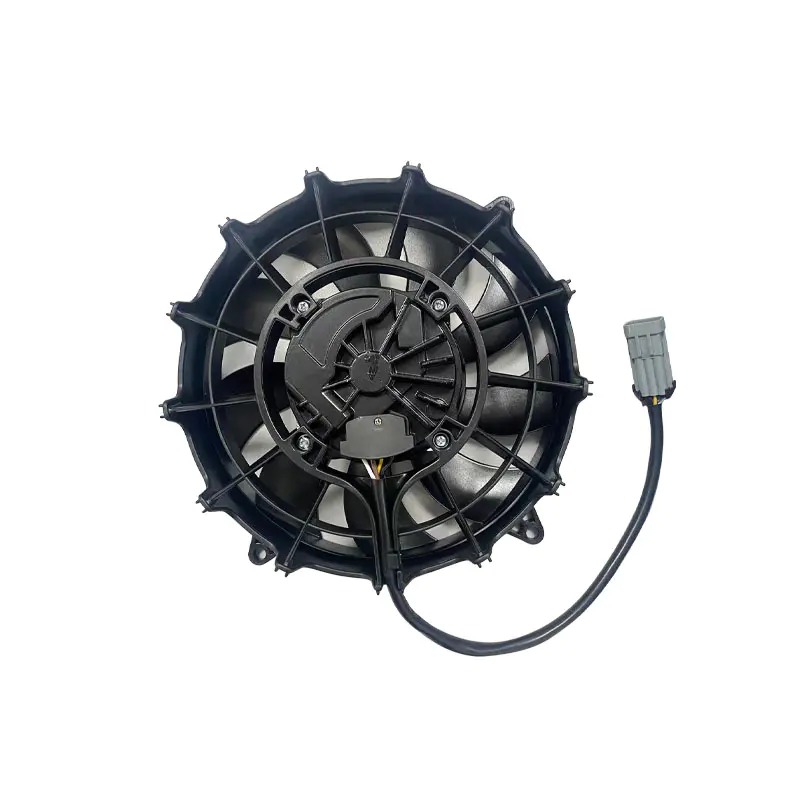
Fan selection is rarely the first decision made in an HVAC design, yet it quietly determines whether the whole duct system performs the way the drawings promised. Backward curved centrifugal fans dominate supply-side duty because they combine moderate pressure capability with predictable efficiency and consistent acoustic behaviour inside a compact housing. Add an EC motor and the package becomes adjustable, replacing a fixed speed plus a mechanical damper with continuous speed modulation that can be measured and reported.
What follows moves from the aerodynamic side through selection arithmetic, then into materials, control, installation and upkeep. The goal is to put the numbers an engineer actually has to enter on a selection sheet into one place.
A credible specification sheet rests on three independent design decisions: how the motor is commutated, how the blades leave the hub, and how the air leaves the impeller. Treating those three as interchangeable parts is the single most common reason a delivered unit stops matching its data sheet.
EC stands for electronically commutated, which means the switching that drives the stator is handled by power electronics built into the motor can or into a small dedicated control box. Compared with a fixed speed induction motor the practical difference is not just efficiency at one operating point. It is that speed can be varied continuously across a wide band without the efficiency penalty that comes from spilling or throttling. In a variable air volume system that quality matters more than the peak figure, because most running hours sit below rated duty.
This describes impeller geometry. A backward curved impeller carries blades that lean away from the direction of rotation, which opens up the blade passage and accelerates the air more gently. Forward curved impellers do the opposite: they build pressure faster at a given diameter and speed, but they pay for it with a lower peak efficiency and a much steeper efficiency curve that collapses once flow drifts away from the best point. Backward curved geometry holds its efficiency across a wider flow band, which is exactly what a system with dirty filters and part-load hours needs. The wider passages are also less prone to collecting dust, and the topic is examined in more depth in this note on the back curved blade centrifugal fan.
Air enters along the axis of the impeller, picks up energy from the blades, and is thrown radially outward into a scroll that converts a share of the velocity pressure into static pressure before the outlet. That ninety degree turn is the reason a centrifugal fan can develop far more static pressure than an axial fan of similar diameter, and it is precisely the quality a designer needs once filters, coils and long duct runs start adding resistance.
| Characteristic | Forward curved impeller | Backward curved impeller |
|---|---|---|
| Pressure at a given speed | Higher | Lower, reached at higher speed |
| Peak efficiency | Lower | Higher |
| Efficiency curve shape | Steep, falls quickly off the best point | Flat, holds across a wide flow band |
| Noise character | Higher, strong low frequency content | Lower, broader spectrum |
| Dust accumulation | More likely in narrow passages | Less likely in wider passages |
| Typical HVAC duty | Compact coil units and short low pressure runs | Air handling units, cleanrooms, data hall cooling, heat pumps |
Two data sheets can look almost identical and still describe very different machines. The table below ranks the parameters by how much they influence design, commissioning and long term energy use.
| Parameter | Why it matters | Common specification error |
|---|---|---|
| Volumetric flow, m3/h | Sets the delivered air quantity at the duty point | Reading standard condition flow as running condition flow |
| Static pressure, Pa | Must cover the clean filter and the loaded filter case | Sizing against brand new filters only |
| Speed, rpm | Defines the modulation range and the signal mapping | Assuming the full signal range equals the full speed range |
| Input power, W | Drives circuit sizing and running cost | Comparing a single point figure instead of the whole band |
| Sound pressure level, dB(A) | Determines comfort and room acoustics | Comparing numbers measured at different distances |
| Control interface | Decides wiring to the controller and the building system | Discovering a signal mismatch during commissioning |
| Supply voltage range | EC electronics tolerate a wide input band | Sizing transformers from the nominal voltage alone |
| Ambient temperature limit | Caps usable speed and expected life | Confusing duct air temperature with ambient around the motor |
Sound pressure level and sound power level are routinely mixed up in tender documents. Pressure level depends on the room and the measurement distance, power level belongs to the machine. Only the second one can be compared reliably across suppliers.
The workflow below is deliberately ordered so that each step constrains the next one rather than being revisited later.
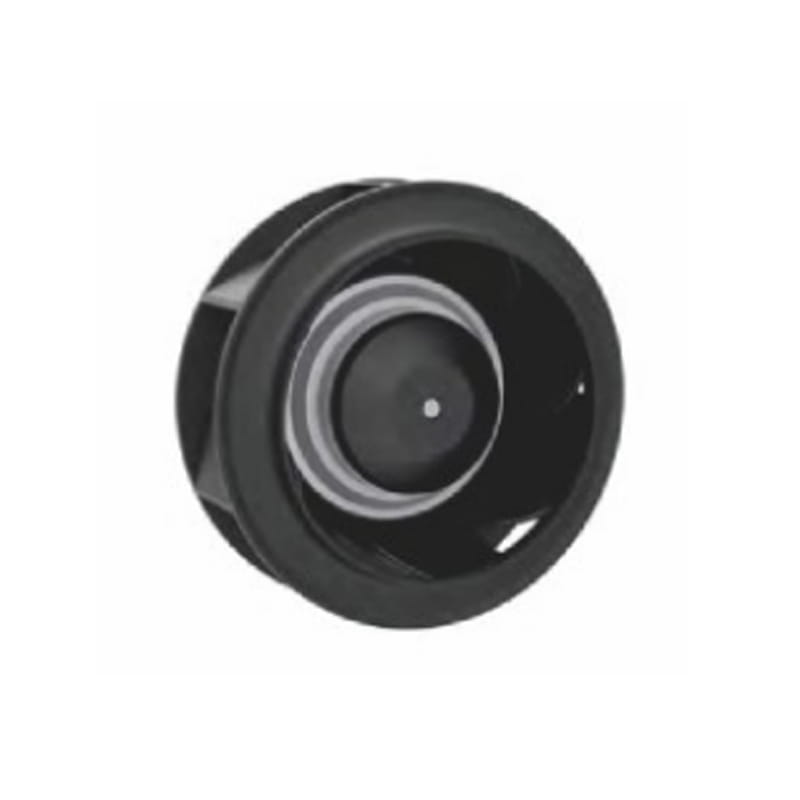 EC72-B190 EC Backward Tilting Brushless Centrifugal FanSpecification ARTICLE. NO EC Backward Tilting Centrifugal Fan Voltage 220/230V (support customization) Wind of ≥105W Applicable Reversible universals Current ≤0.87A Tu...View Product →
Part load is the normal state of a fan, not the exception. Across a year the unit may spend half its hours at sixty per cent of rated flow while the building is lightly occupied or the outdoor temperature is mild. A design with a very high peak efficiency but a steep curve can end up consuming more energy over that period than a design whose peak is a few points lower but whose curve stays flat. When comparing options, integrate the expected load duration rather than comparing single points.
An indoor air handling unit rarely needs more than IP20. Rooftop plant, cooling tower surroundings and any location subject to washdown call for IP54 or better. Condensation is the more subtle threat than direct water entry, because a film of moisture forming on a circuit board eventually corrodes the tracks. Cycling between warm and cool air makes condensation far more likely than steady humidity alone, so a motor with sealed windings and a drainage path is worth the premium.
The control interface decides how the fan behaves over its life far more than the static pressure figure does. The common options are worth understanding before the wiring schedule is issued.
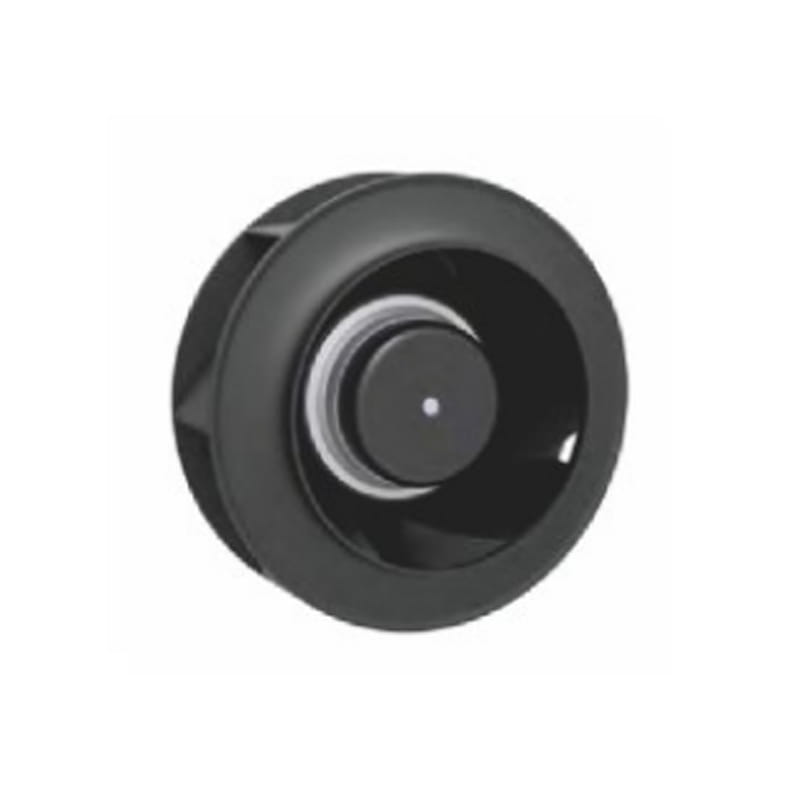 EC72-B250 EC Automotive Backward Tilting Centrifugal FanSpecification ITEM. NO EC backward-tilting centrifugal fan Voltage 220/230V(Support customization) Wind from ≥105W Applicable Universal Reversible Current ≤0.87A Turn ...View Product →
Parallel operation deserves a separate check. When two or more fans work into a common plenum their speeds must match, or at least stay very close. A noticeably slower unit in the group gets pushed backwards by its faster neighbours, and the result is a set of fans that partly do nothing while the rest run overloaded. Driving a group from one shared control signal and splitting only by zone avoids the problem entirely.
The pattern across these duties is consistent: duct systems with meaningful resistance, tight installation space, and a need to modulate rather than simply switch on and off.
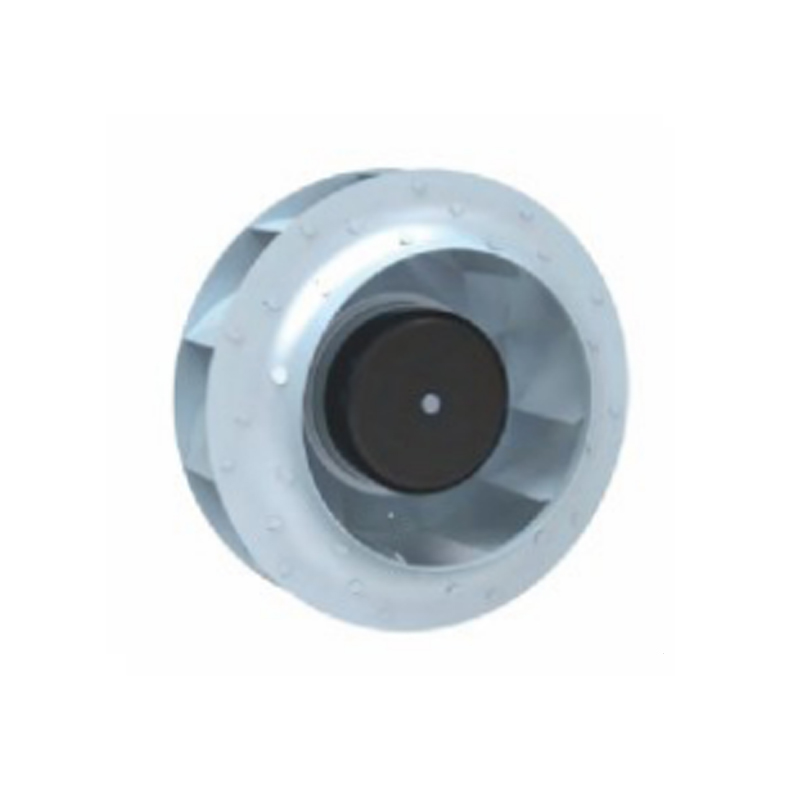 EC92-B225 EC Radiator Backward Tilting Centrifugal FanSpecification ITEM. NO EC backward-tilting centrifugal fan Voltage 220/230V(Support customization) Wind from ≥135W Applicable Universal Reversible Current ≤1.05A Turn ...View Product →
Whenever a project needs the same airflow but only half the available pressure, the answer is usually not a larger fan running slowly. It is a smaller impeller at a higher speed, which is lighter, cheaper and often quieter at the duty point.
| Symptom | Likely cause | Action |
|---|---|---|
| Flow below design value | Loaded filters, fouled coil, dusty impeller, blocked inlet | Survey the whole duct system, clean the impeller and recheck the duty point |
| Sudden rise in noise | Worn bearing, foreign object on a blade, structural resonance | Inspect the bearing, remove debris and isolate the resonant panel |
| Repeated thermal cut out | High ambient, excessive duct resistance, speed set above rating | Reduce ambient temperature or rebalance the operating point |
| Erratic speed | Interference on the control cable, loose terminal, unstable signal source | Verify shielding, earthing and terminal torque |
| Motor does not start | No control signal, reversed polarity, locked rotor protection active | Measure signal voltage and confirm wiring sequence |
A six to twelve month inspection interval suits most installations. Cleaning the impeller restores both airflow and balance, and checking terminal torque prevents the intermittent faults that are hardest to trace later.
It is used wherever a duct system has meaningful resistance and the airflow has to be modulated rather than simply switched. Typical duties include air handling units, cleanroom supply, data hall cooling and heat pump outdoor sections. The backward curved impeller supplies the pressure and efficiency, while the EC motor supplies the adjustable speed.
The difference comes from how the air is accelerated inside the blade passage. Backward curved blades turn the flow more gently through wider passages, so less energy is lost to turbulence. Forward curved impellers rely on vigorous acceleration to build pressure quickly, which is compact and cheap but produces a lower peak efficiency and a curve that falls away sharply.
Choose EC when the load varies and running energy matters, because speed can be varied continuously with good efficiency across the band. Choose an AC motor with a separate inverter when the duty is fixed and the fan runs at full speed almost all the time, accepting the extra wiring and the weaker low speed performance.
Most EC motors tolerate continuous low speed operation. Two details deserve attention. First, bearing lubrication must suit prolonged low speed running. Second, the motor relies on its own airflow for cooling, so at very low speed the heat generated inside the can is no longer carried away as effectively, and a lower ambient limit may apply.
An axial fan pushes air straight through along the shaft axis. It moves a large volume at low static pressure, but the flow falls off rapidly as duct resistance rises. A centrifugal fan turns the air through ninety degrees, which allows much higher static pressure and makes it the better choice once filters, coils and long duct runs are involved.
For most HVAC installations an inspection every six to twelve months is sufficient. The check covers impeller cleanliness, bearing noise, terminal tightness and the condition of the flexible connector. Units running in dusty or greasy exhaust duty should be inspected more frequently, since deposit build up on the blades degrades both airflow and balance.
Selecting an EC backward curved centrifugal fan for an HVAC application comes down to matching impeller geometry, motor and control interface to a realistic system curve rather than to a clean filter ideal case. Size against the conditions the unit will actually meet, keep a sensible part load margin, and the fan will hold its duty quietly for years. That discipline reflects decades of electric motor and fan assembly manufacturing experience across automotive and industrial cooling applications, where the same principle applies on every platform.
Din e-postadress kommer inte att publiceras. Obligatoriska fält är markerade *

Zhejiang Nicety Electric Machinery Co., Ltd. specialiserar sig på produktion av fyra serier av produkter: elektronisk kondensatorfläkt, kylare (vattentank), fläkt, och luftkonditioneringsaggregat. Professionell produktion Amerikanska, europeiska, japanska, koreanska och inhemska DC-axialfläktar för bilar.
Email: [email protected] / [email protected]
Tel: +86-0578-7125439 / +86 181 0658 9231
Address:98, Guangda Street, Jinsha Industrial Zone, Longquan City, Zhejiang-provinsen, Kina